
How to Choose the Best Digital Marketing Course in Lucknow (2026 Guide)
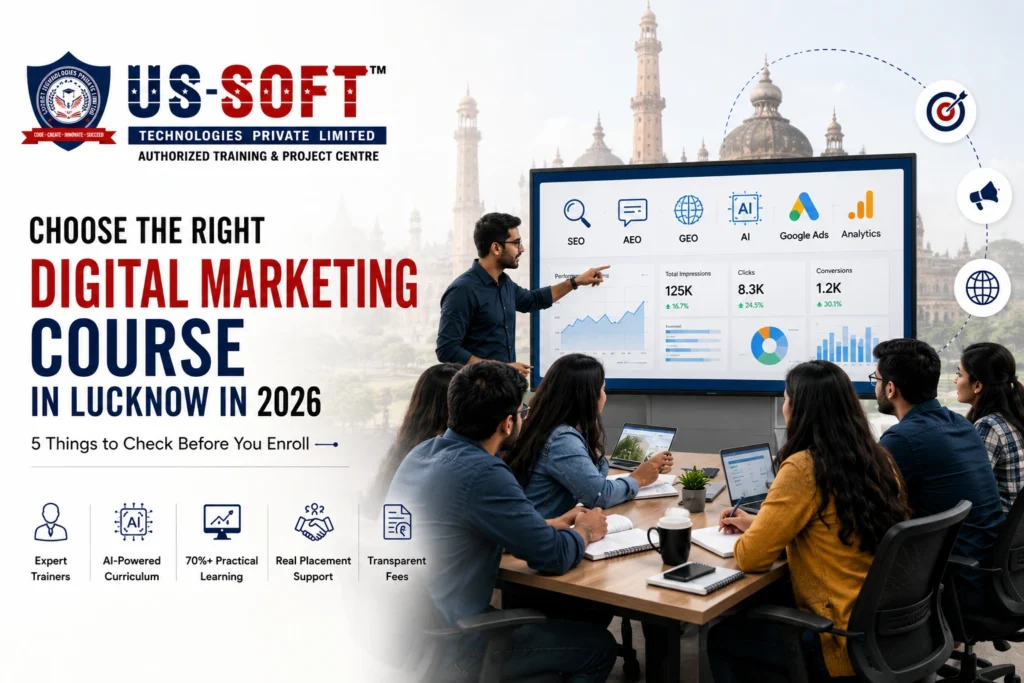
The best digital marketing course in Lucknow in 2026 isn’t the one with the flashiest brochure — it’s the one where you can verify five things before paying a rupee: the trainer is an active practitioner (not a slide-reader), the curriculum covers AI skills like AEO and GEO alongside classic SEO and Ads, at least 70% of the course is hands-on with real client budgets, the “placement support” is clearly defined rather than vaguely promised, and the fee is transparent with no hidden add-ons. If a course in Lucknow ticks all five boxes, it’s worth your money. If it’s missing even two, keep looking.
Lucknow’s digital marketing scene has changed faster in the last eighteen months than in the five years before it. Demand for digital marketers in the city has grown by roughly 35% in the last year alone, driven by local startups, e-commerce sellers, and healthcare and education brands that finally moved their budgets online. That’s the good news. The complicated part is that dozens of institutes across Aliganj, Gomti Nagar, Mahanagar, and Chinhat are now selling “AI-powered” courses, and most students have no reliable way to tell a genuinely updated curriculum from a repackaged 2022 syllabus with a ChatGPT logo pasted on the cover. This guide breaks down exactly what to check.
Why 2026 Changed the Rules
Two numbers explain why the old way of picking a course — “which institute has the biggest hoarding?” — no longer works.
First, a large share of Indian employers, by some estimates as many as 82%, say they struggle to find candidates who can actually demonstrate measurable results, not just recite definitions of SEO or run a Facebook boost. A certificate alone stopped being proof of competence a while ago.
Second, AI Overviews and AI-generated answers now show up in a majority of search queries — commonly cited around 60% — which means brands are no longer just competing for the traditional “ten blue links.” They’re competing to be cited inside an AI answer. A course that only teaches keyword research and on-page SEO is teaching half the subject. The other half — Answer Engine Optimization (AEO) and Generative Engine Optimization (GEO) — barely existed in most Lucknow syllabi two years ago.
Meanwhile, the money on the table is real. Freshers in Lucknow typically start between ₹15,000 and ₹25,000 a month, and experienced specialists — particularly those comfortable with AI-assisted workflows — can cross ₹80,000 a month, sometimes while working remotely for companies based in Delhi or Bangalore without leaving the city. A ₹25,000–₹75,000 course fee, for someone who lands a job in that range, typically pays for itself within two to three months. That math only works, though, if the course itself is worth the fee — which brings us to the five things you actually need to check.
Pillar 1: Is the Trainer an Active Practitioner or a Career Teacher?
This is the single most important filter, and it’s the one most students skip.
There’s a real difference between someone who teaches digital marketing and someone who does digital marketing for a living and teaches on the side. A trainer who hasn’t personally run a live ad campaign or managed a real client account in the last year or two is, by definition, teaching an outdated version of the subject — algorithms, ad platforms, and AI tools change too fast for anyone to stay sharp from memory alone.
Before you enroll anywhere in Lucknow, ask a direct question: “Can I see a live campaign dashboard you’re currently managing?” A genuine practitioner will show you one, sometimes with client names blurred for confidentiality. Someone who deflects with “we focus on teaching fundamentals” is telling you something important without meaning to.
This single question filters out a surprising number of institutes fast, because most of Lucknow’s digital marketing faculty are themselves graduates of other local institutes, cycling knowledge between classrooms rather than bringing in fresh, current, real-world practice.
Pillar 2: Does the Curriculum Actually Cover 2026 Skills?
Traditional SEO and a basic social media calendar are now baseline skills — useful, but no longer differentiators. A 2026-ready course needs to go further and include:
- Generative AI workflows — using tools like ChatGPT for strategy and ideation, and image models for ad creatives, as a daily part of the job rather than a one-off demo class.
- Answer Engine Optimization (AEO) — structuring content so it gets pulled into featured snippets and AI-generated answer boxes.
- Generative Engine Optimization (GEO) — making sure a brand actually gets cited by AI systems like ChatGPT, Perplexity, and Gemini when someone asks a related question.
- Agentic AI concepts — understanding how autonomous AI workflows and automation agents are starting to run repetitive marketing tasks, from reporting to campaign monitoring.
- Real tool fluency — hands-on time with 40 to 60 industry-standard platforms across SEO, ads, design, and analytics, not just a slide showing their logos.
Ask to see the actual module list, not a marketing one-pager. If GEO, AEO, and AI-agent concepts aren’t named anywhere in the syllabus, the course is teaching last cycle’s playbook at this cycle’s price.
Traditional Curriculum vs. AI-Powered Curriculum
It helps to see the gap side by side before you compare fees:
| What You’re Taught | Traditional (2022-style) Course | AI-Powered (2026-Ready) Course |
|---|---|---|
| Search | On-page SEO, backlinks | SEO + AEO + GEO (AI-answer visibility) |
| Content | Manual writing and editing | AI-assisted drafting, human strategy and editing |
| Ads | Manual campaign setup | AI-assisted targeting and creative testing |
| Automation | None | Basic Agentic AI / workflow automation concepts |
| Reporting | Manual spreadsheets | AI-assisted analytics and dashboards |
If an institute’s fee is closer to the AI-powered end of this table but its actual class content matches the left column, you’re paying a 2026 price for a 2022 education. This is worth checking module-by-module, not just accepting the brochure’s word for it.
Pillar 3: The 70:30 Rule — How Much of the Course Is Actually Practical?
Digital marketing is a hands-on trade, closer to plumbing than to philosophy. You learn it by doing it, not by memorizing frameworks.
A legitimate course should dedicate roughly 70% of its time to active, practical work and no more than 30% to theory. But “practical” itself needs a second-level check, because two very different things get called “practical” in Lucknow’s institute market:
- Simulated exercises — dummy accounts, fake budgets, no real consequences if a campaign fails.
- Live client work — real budgets, real business goals, and real accountability for results like return on ad spend or lead volume.
Only the second kind builds a portfolio that means anything to an employer. When you finish a genuinely practical course, you should walk away with clickable proof of your work — live URLs, real campaign reports, an actual analytics dashboard you can screen-share in an interview — not a stack of PDFs and a participation certificate.
Pillar 4: Placement Assistance vs. Placement Guarantee — Know the Difference
Almost every institute in Lucknow advertises “100% placement support.” Very few explain what that phrase actually covers, and the two versions are not the same thing.
Placement assistance usually means help with your resume, mock interviews, and introductions to hiring partners — genuinely useful, but not a promise of a job.
Placement guarantee is a stronger, rarer commitment, often a conditional refund or re-training promise if you aren’t placed — but it typically comes with fine print around minimum attendance, passing internal assessments, and completing every live project.
Before paying, ask the institute directly which one they’re offering, and ask to see it in writing. Then ask for something more useful than either: a list of the last 15–20 graduates along with their current LinkedIn profiles. A verifiable trail of real outcomes tells you more than any brochure claim about “100% placement.”
Pillar 5: Fee Transparency and Realistic ROI
Course fees in Lucknow generally fall in the ₹25,000–₹75,000 range for a comprehensive, multi-month program, with basic short certifications going for less and executive-style diplomas costing considerably more. The number itself matters less than what’s actually included in it.
Ask specifically whether the quoted fee covers:
- Paid tool subscriptions (SEMrush, Canva Pro, and similar), or whether those are billed separately later
- Live ad spend for real campaigns, or whether you’ll be expected to fund test budgets yourself
- Exam and certification costs
- Any AI tool access, given how central this has become to the actual curriculum
A course that is upfront about all of this from the first conversation is a good early trust signal. One that only reveals “additional charges” after you’ve already paid the admission fee is a red flag regardless of how good the sales pitch sounded.
On the return side, the ROI math is straightforward: a ₹35,000–₹50,000 course that leads to even an entry-level ₹18,000–₹20,000/month role typically pays for itself within two to three months of your first salary. It’s a genuinely good trade — provided the course actually delivers the skills that get you hired.
A Short Red-Flag Checklist
Before you sign up anywhere in Lucknow, walk through this list:
- Does the trainer avoid showing any current, live client work?
- Is “AI integration” mentioned only in the brochure and never in the actual module list?
- Are you shown simulated projects when you ask for practical proof?
- Does the institute dodge a clear answer on “assistance” vs. “guarantee”?
- Are there vague answers about what the fee does and doesn’t include?
Two or more “yes” answers, and it’s worth continuing your search rather than signing the enrollment form that day.
My Own Path Into This Field
I didn’t start in a classroom — I started freelancing in 2018, picking up small content writing gigs through Facebook groups because that was the only entry point available at the time. There was no structured course to follow, no mentor to check my work, and a lot of trial and error that could have been shortened dramatically with the right guidance. What eventually got me from freelance writer to running a training institute wasn’t a certificate — it was slowly building real client work, one project at a time, and being forced to actually understand what moved the needle for a business rather than what looked good in a report.
That’s the exact gap I try to close for students now: the years I spent figuring things out the hard way are the shortcut I want to hand to someone starting today. It’s also why I’m fairly blunt about the five pillars above — I’ve seen, from both sides of the table, how much time and money gets wasted when a course promises more than it can verify.
Why Local, Regional-Language Campaigns Matter for Lucknow Learners
One thing a good Lucknow-based course should teach that a generic national curriculum often skips: campaigns built in Hindi and regional context for local audiences tend to convert meaningfully better than a straight English translation of a metro-city campaign — some data points to conversion lifts as high as 65% for genuinely localized messaging. If you’re planning to work with Lucknow’s own retail, education, or healthcare businesses — and most fresh graduates start exactly there — understanding how to write and target campaigns in the language your actual audience thinks in isn’t optional. It’s a core, practical skill, not an afterthought.
Key Points
- Lucknow’s digital marketing job market has grown roughly 35% in a year, with real salary ranges from ₹15,000–₹25,000/month for freshers to ₹80,000+ for experienced, AI-skilled specialists.
- The single best filter for any course is whether the trainer is actively running campaigns right now, not just teaching from memory.
- A 2026-ready syllabus must include AEO, GEO, and Agentic AI concepts alongside traditional SEO and Ads — not as an add-on module, but as the baseline.
- Insist on a 70:30 practical-to-theory ratio with live client budgets, not simulations.
- Know the difference between “placement assistance” and “placement guarantee” before you pay, and ask for verifiable alumni proof.
- Fee transparency — knowing exactly what’s included — matters as much as the fee amount itself.
Frequently Asked Questions
What is the best digital marketing course in Lucknow for a complete beginner?
Look for a course built around the five pillars above rather than a specific brand name — an active-practitioner trainer, a 2026-ready AI curriculum, a 70:30 practical ratio, clear placement terms, and transparent fees. Beginners specifically benefit from courses with live, in-person doubt resolution and structured weekly progress.
How much does a good digital marketing course in Lucknow cost?
Comprehensive, professional-level programs in Lucknow typically range from ₹25,000 to ₹75,000, with most quality mid-range courses sitting between ₹35,000 and ₹50,000. The fee should include tool access and live project budgets, not just classroom hours.
Is an online digital marketing course in Lucknow as good as an offline one?
It depends on what you need. Offline and hybrid formats tend to work better for complete beginners who benefit from in-person feedback and local networking, while online formats suit working professionals who need scheduling flexibility. Whichever format you choose, the same five pillars still apply.
How long does it take to become job-ready after a digital marketing course in Lucknow?
Most structured programs with live projects get students job-ready within three to six months, assuming the course genuinely follows a practical-heavy structure rather than a theory-heavy one.
Final Thought
Lucknow’s digital marketing opportunity in 2026 is real — the demand, the salaries, and the remote-work upside all check out. But the course you choose determines whether you’re one of the graduates employers fight over or one of the many with a certificate and no verifiable skill to show for it. Use the five pillars in this guide as your checklist for any institute you’re considering, ask the direct questions, and don’t enroll anywhere until you’ve gotten a straight answer to all of them.
If you’d like to see how our own Advanced Digital Marketing with Agentic AI program stacks up against this checklist, you can explore the full curriculum on our Courses page or book a free demo class to ask these questions in person.