
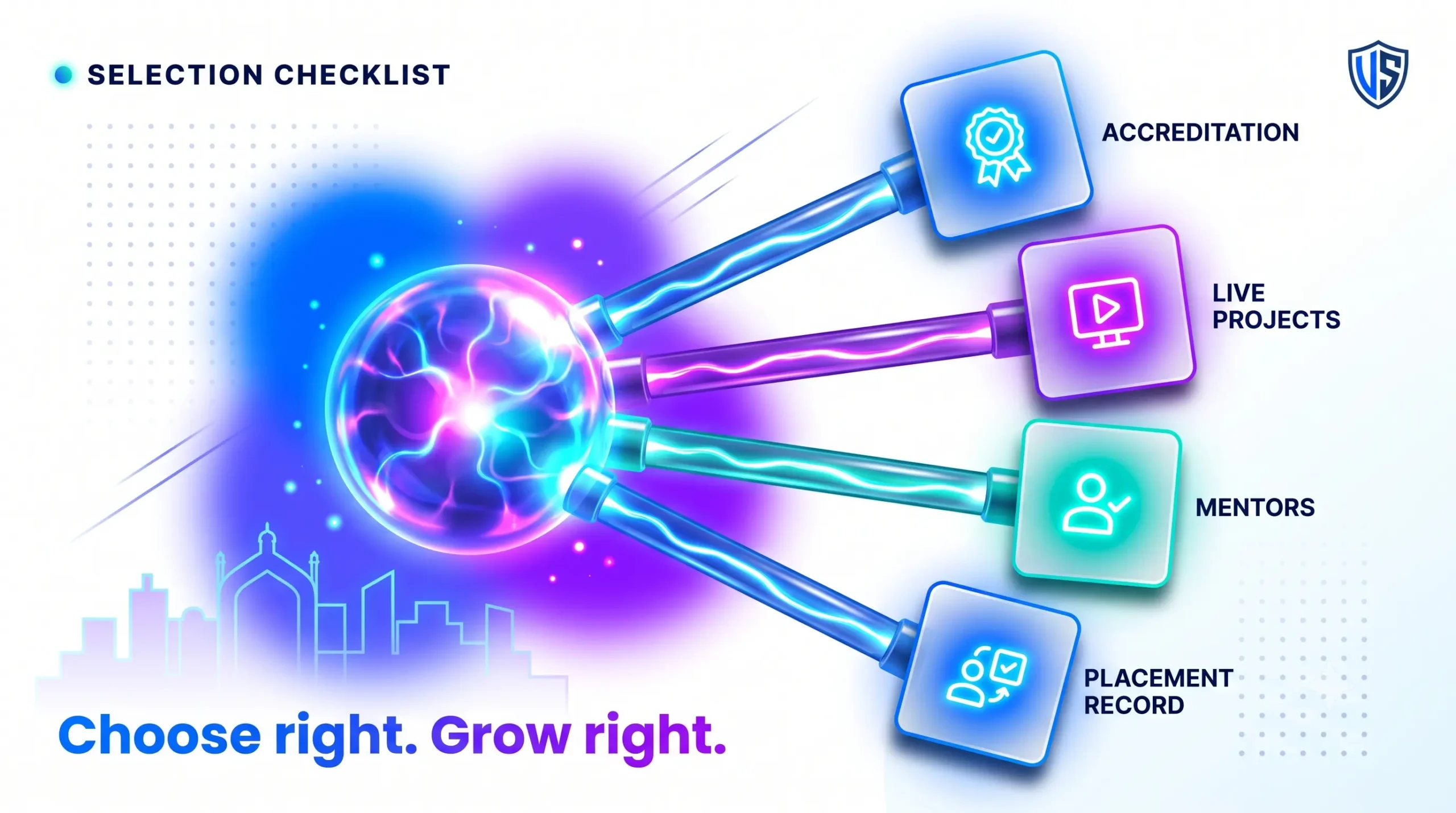
How to Choose the Best Digital Marketing Institute in Lucknow
The best digital marketing institute in Lucknow is the one where the trainer is actively running campaigns right now — not the one with the most Google ads, the biggest banner on the highway, or the longest list of promised certifications. That single criterion filters out roughly 70% of institutes in any city, including Lucknow.
I’ve been running a digital marketing training institute in Lucknow since building my own freelancing career from scratch in 2018. Before that, I was on the other side of this decision — figuring out what to learn, from whom, and whether it was worth spending money I didn’t have on a course I couldn’t verify. Everything in this guide comes from that experience, both sides of it.
Key Points
- The trainer’s current practitioner status matters more than institute brand name or certification count
- A 2026-ready syllabus must include AI-integrated workflows, AEO, GEO, and Agentic AI — not just basic SEO and social media
- Practical-to-theory ratio should be at least 70:30, with real client campaigns, not simulations
- “Placement Assistance” and “Placement Guarantee” mean different things — know the difference before enrolling
- Red flags: Google rating below 4.0, no free demo class, “earn ₹1 lakh/month” promises, vague “industry expert” trainer bios
- Entry-level salaries in Lucknow: ₹15,000–₹25,000/month; experienced professionals: ₹80,000+/month
Why Lucknow’s Digital Marketing Market Is Growing Right Now
Before choosing an institute, understand why the demand for this skill exists in Lucknow specifically — because the local context shapes what you actually need to learn.
Lucknow’s startup ecosystem has grown significantly over the last three years. E-commerce businesses, EdTech platforms, food delivery operations, and local healthcare brands have all scaled their digital presence and need people who can manage that presence. The national context supports this: India’s digital advertising market is projected to hit ₹539 billion, with over 20 lakh jobs being created across the country — and a meaningful share of that demand is now in Tier-2 cities, not just metros.
The salary reality in Lucknow is honest rather than glamorous at entry level. Freshers typically start at ₹15,000–₹25,000 per month. That’s not the ₹50,000 starting salary some institutes promise in their brochures — but it’s a real, employable starting point that climbs quickly with the right specialization. Experienced professionals in Lucknow are earning ₹80,000+ per month, and those with remote or freelance income often exceed that figure significantly.
The demand is real. The question is whether the institute you choose actually prepares you for it, or just sells you a certificate and a handshake.
Pillar 1: Is the Trainer Currently Practising?
This is the single most important question to ask, and most people don’t ask it.
A trainer who left active digital marketing work two or three years ago is teaching you a version of the field that no longer exists. Digital marketing in 2026 operates differently from digital marketing in 2023 — AI Overviews have restructured SEO, Meta’s ad algorithms have changed significantly, and the entire content strategy landscape now requires AI fluency. A trainer not working in this environment daily cannot teach it accurately.
When I started teaching, I made a deliberate decision to keep running active campaigns and client projects alongside the institute — not because it was easy to manage both, but because the moment I stopped practising, I’d start teaching an outdated version of the field. Every trainer worth learning from should be making that same trade-off.
How to verify this before enrolling: ask the trainer which clients or campaigns they’re currently managing. Ask to see a live dashboard. Ask what’s changed in their strategy in the last six months. Vague answers about “industry experience” and generic “expert” titles are red flags, not credentials.
Pillar 2: Does the Syllabus Reflect 2026, Not 2022?
Most institutes in Lucknow — and across India — are still teaching a digital marketing curriculum that was relevant three to four years ago. Basic SEO, social media scheduling, Google Ads setup, and some content writing. That’s the 2022 syllabus. It’s not worthless, but it’s incomplete for 2026.
A genuinely current syllabus needs to include:
AI-Integrated Workflows — using ChatGPT, Claude, and Gemini not as novelties but as standard production tools for content, research, and campaign analysis.
Answer Engine Optimization (AEO) — structuring content to appear in AI-generated answers, not just Google blue links. This is where search is moving, and it’s already affecting traffic for every business with an online presence.
Generative Engine Optimization (GEO) — building brand visibility across AI platforms including ChatGPT, Perplexity, and Google AI Overviews.
Agentic AI Systems — understanding how autonomous AI workflows are changing marketing automation and what that means for campaign management.
Ask any institute you’re considering: “Is AEO or GEO part of your curriculum?” If they don’t know what those terms mean, that tells you everything you need to know about how current their teaching is.
Also ask when the syllabus was last updated. A syllabus that hasn’t been revised in the last six months is already falling behind. [Check which certifications are included] — certifications matter, but only if they’re attached to a curriculum that’s actually current.
Pillar 3: What Is the Practical-to-Theory Ratio?
This is where most institutes fail quietly, without students realizing it until after they’ve enrolled and are two months in.
The standard that actually produces employable graduates is a 70:30 ratio — 70% practical, 30% theory. This means the majority of class time is spent doing, not listening. Running live campaigns. Analyzing real data. Writing actual content for real websites.
The test to apply before enrolling: ask what “practical training” specifically means at that institute. Two answers reveal the difference immediately.
A genuine answer sounds like: “Students work on live client accounts with real budgets. They manage actual ad campaigns, track real analytics data, and produce content that gets published on real websites. By the end of the course, they have a portfolio of verifiable work.”
A vague answer sounds like: “We give lots of assignments and hands-on practice.” No specifics, no real clients, no real budgets. This usually means simulated projects in a classroom setting — which is better than pure theory but significantly less valuable than real-world application.
When I design curriculum at our institute, the benchmark I apply is simple: can a student show a potential employer or client exactly what they did, on which campaign, with which results? If the answer is yes, the training was practical. If the portfolio is full of theoretical assignments and fake business case studies, the training was not.
Pillar 4: Decoding Placement Promises Honestly
“100% Job Placement Guarantee” is one of the most common phrases in Lucknow’s digital marketing institute marketing. It’s also one of the most misleading.
Here’s the distinction that matters:
Placement Assistance means the institute will help you with resume writing, interview preparation, and connecting you with job listings. It does not guarantee you a job. It means they’ll try to help.
Placement Guarantee at most institutes is conditional — it applies only to students who complete the course with a certain attendance percentage, score above a threshold in assessments, and actively participate in placement activities. Read the fine print. The guarantee is usually for entry-level roles at ₹12,000–₹18,000/month — not the ₹35,000+ figure that might appear in the marketing material.
A specific red flag: any institute offering a “100% Placement Guarantee” without requiring any entrance or aptitude assessment before enrollment. If they’ll take anyone regardless of baseline skills, the guarantee is essentially meaningless — they’re guaranteeing placement at a level that requires very little skill verification.
The more honest question to ask isn’t “do you guarantee placement?” It’s “show me where your last 20 graduates are working right now.” LinkedIn profiles. Job titles. Company names. Actual proof. [See real student success stories] — because real placement proof looks like verified graduate profiles, not testimonial videos with no verifiable details.
Pillar 5: Infrastructure and Tools Access
A digital marketing institute should feel like a working marketing environment, not a coaching centre. The physical and digital infrastructure tells you a lot about how seriously an institute takes practical training.
On the tool side, a professional institute should ensure students get hands-on experience with 40–60 industry tools across categories. This includes:
AI Tools: ChatGPT, Claude, Gemini — for content production, research, and strategyDesign Tools: Canva Pro — not the free version, because professionals use the full suiteTechnical SEO Tools: Semrush, Ahrefs, Screaming Frog — these are industry-standard and expensive; access to them during training is a significant advantageAnalytics: Google Analytics 4, Google Search Console, Meta Business Suite
If an institute is teaching digital marketing without providing access to these tools during training, students are learning theory about tools they’ve never actually used — which creates a gap that becomes immediately visible in a job interview.
The physical environment matters too. Dedicated computers, stable internet, a professional classroom setup that mirrors a corporate workspace — these aren’t luxuries. They’re the baseline for professional training. Walk into the institute before you enroll. If it feels like a cramped coaching centre with projectors pointed at walls, that environment shapes the professional habits you develop during training.
Pillar 6: Accreditations That Actually Mean Something
Not all accreditations carry equal weight. Here’s a quick guide to what’s worth verifying:
ISO 9001:2015 Certification — confirms quality management standards are in place. Worth having; not sufficient on its own.
Google Partner Status — this one matters specifically because it indicates the institute meets Google’s requirements for ad performance and employee certification. It’s verifiable directly on Google’s partner directory — don’t just take the institute’s word for it.
Meta Blueprint Certification — confirms the institute is aligned with Meta’s official advertising education program.
A note of honesty: some certifications displayed by institutes are self-issued, association-based, or simply purchased memberships rather than earned credentials. The ones that matter are the ones you can independently verify through the certifying organization’s website. If an institute is evasive about how to verify their accreditations, that’s a red flag.
How to Identify Fraud Before You Pay a Rupee
Lucknow, like most cities, has a range of institutes operating between legitimate training centers and outright scams. Here are the specific signals that should make you walk away:
Google Rating Below 4.0 — look at the actual reviews, not just the rating. Patterns of repetitive, generic, suspiciously similar reviews with no response to negative feedback are signs of managed reputation rather than genuine student satisfaction.
No Free Demo Class — a legitimate institute has nothing to hide. The demo class is where you assess the trainer’s depth of knowledge, communication style, and how current their examples are. Any institute that won’t offer a free demo before taking your money is removing your most important evaluation opportunity. Walk away.
“Earn ₹1 Lakh in a Month” Promises — digital marketing income is real and can be significant, but freshers do not earn ₹1 lakh per month. Experienced professionals with strong specializations earn that. Using it as an enrollment hook is either ignorance or deliberate deception.
Vague Trainer Bios — “Our faculty are industry experts with years of experience.” How many years? In what specifically? At which companies or clients? Legitimate trainers have verifiable, specific credentials. Vague bios are hiding something.
No Physical Address or Walk-In Option — any institute operating only online with no physical presence in Lucknow and no option to visit before enrolling should be approached with significant caution.
Bootcamp vs. Advanced: Which Course Type Do You Actually Need?
The Lucknow market has two primary course structures, and the right one depends entirely on what you’re trying to achieve.
Essential/Bootcamp (3–4 months) is best suited for content creators, freelancers, small business owners, and anyone who needs functional digital marketing skills quickly. It covers design, video, social media, and basic SEO. It’s not sufficient for getting a full-time digital marketing role at a company, but it’s the right entry point for someone who wants to run their own social media, do freelance work, or understand enough to manage an agency relationship.
Advanced/Flagship (6–12 months) is the right choice for anyone serious about a career in digital marketing. This covers technical SEO, performance marketing, analytics, AI-integrated workflows, and agency management. The longer timeline exists because these skills require practice over time, not just instruction. This is also the track that produces the portfolio depth needed to [compare course fees before deciding] in context — the advanced course costs more, but the salary differential between basic and advanced graduates is significant enough to justify it within the first year of employment.
If you’re a business owner who wants to understand digital marketing well enough to oversee an agency without being dependent on them, the bootcamp format is probably sufficient. If you want to start a career in digital marketing and compete for roles against graduates from across the country, the advanced track is not optional — it’s the baseline.
The Questions to Ask Before You Enroll
Based on everything above, here’s the actual checklist to bring with you when you visit any institute:
- Can I speak with the trainer who will actually teach my batch, not a sales representative?
- Which clients or campaigns is that trainer currently managing?
- When was your syllabus last updated, and does it include AEO, GEO, or Agentic AI?
- What is the practical-to-theory ratio, and what does “practical” specifically mean here?
- Can I see examples of student portfolios from the last batch?
- Where are your last 20 graduates currently employed? Can you show me LinkedIn profiles?
- What exactly does your placement support include, and what are the conditions on any guarantee?
- Which tools will I get hands-on access to during the course?
- How do I independently verify your certifications and accreditations?
- Can I attend a free demo class before making any payment?
An institute that answers all ten questions directly, with specifics and verifiable evidence, is worth serious consideration. An institute that deflects, generalizes, or pressures you to enroll before you’ve seen a demo class is not.
The Bottom Line
Choosing the best digital marketing institute in Lucknow isn’t about finding the most famous name or the lowest fee. It’s about finding a trainer who is actively practising, a curriculum that reflects 2026 rather than 2022, and a practical environment where you leave with a portfolio of real work rather than a folder of theoretical assignments.
The market in Lucknow is real. The demand for skilled digital marketers is real. The path from enrollment to employment — or freelancing income — is shorter in this field than almost any other professional skill area. But none of that matters if the institute you choose is teaching you an outdated version of the field.
Do your research. Visit before you pay. Sit in a demo class. Ask specific questions and expect specific answers. [See real student success stories] before you decide, and [compare course fees before deciding] against what each course actually delivers.
If you want to understand how our curriculum at USSOFT is built specifically for the 2026 market — including AI-integrated workflows, AEO, and the tools actually used in the industry right now — [our full Lucknow digital marketing roadmap] is the right place to start. And for a direct comparison of what separates different institutes in the city, [a detailed side-by-side comparison] covers exactly that.