
⚡ Quick Answer: How Many Internet Users Are in India in 2026?
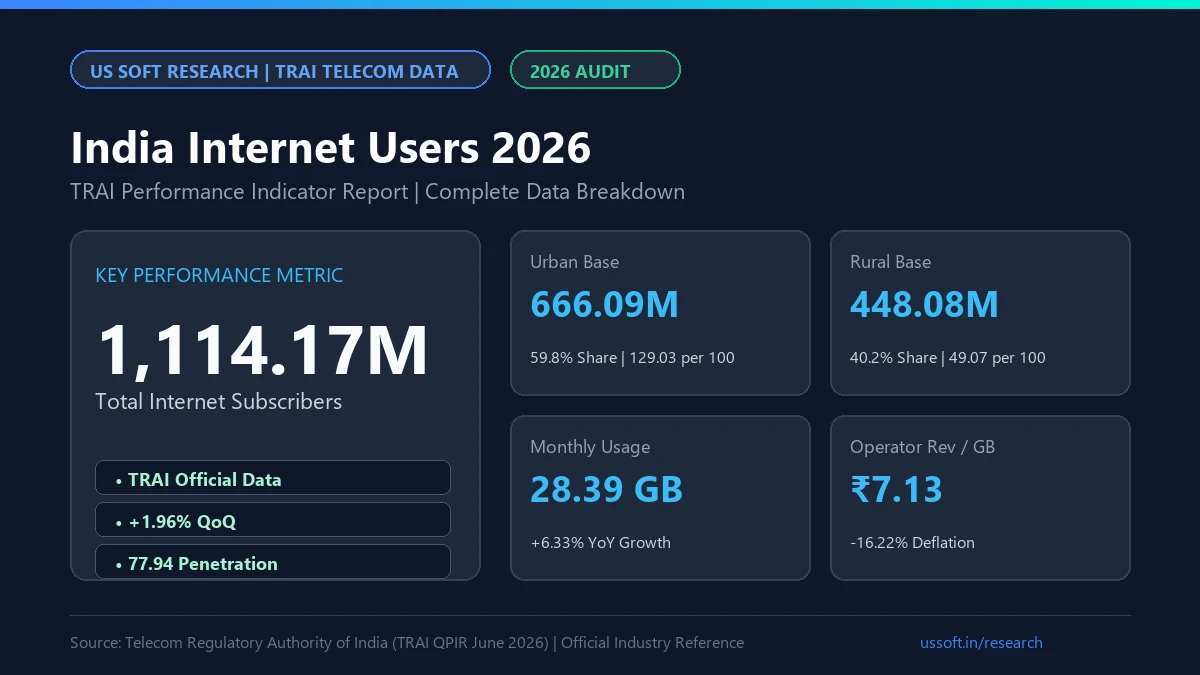
According to the Telecom Regulatory Authority of India (TRAI) in its official Indian Telecom Services Performance Indicator Report (for the quarter ending June 30, 2026), India has 1,114.17 million (1.11 billion) total internet subscribers. This reflects a +1.96% quarter-over-quarter (QoQ) growth from 1,092.79 million in March 2026. Urban subscribers stand at 666.09 million (59.78%), while rural subscribers account for 448.08 million (40.22%). National internet penetration stands at 77.94 subscriptions per 100 population, and mobile data consumption averages 28.39 GB per user per month.
When news headlines proclaim that India has crossed 1.1 billion internet users, they often gloss over the nuanced reality behind the numbers. For growth marketers, enterprise planners, and agencies optimizing their digital presence, understanding the distinction between gross regulatory subscriptions and active human citizens is vital.
At US Soft Lucknow, we train students and digital marketing professionals to look past superficial vanity metrics. In this comprehensive benchmark, we synthesize the latest primary data from the Telecom Regulatory Authority of India (TRAI) to provide an authoritative, auditable teardown of India’s internet landscape in 2026.
1. Headline Figures vs. Real Users: Unpacking the 1.11 Billion Metric
TRAI measures active connections on telecom carrier logbooks (Reliance Jio, Bharti Airtel, Vodafone Idea, and BSNL). Consequently, every data-enabled SIM card is counted as an independent subscriber line. If an urban professional carries a dual-SIM smartphone with both lines holding active data plans, TRAI logs two subscribers, even though only one individual is browsing.
Furthermore, India currently has 99.29 million Machine-to-Machine (M2M) non-human connections (smart power meters, FASTags, and POS swipe boxes). When these non-human devices are isolated and multi-SIM duplication is normalized, India’s actual individual human internet user base is between 850 million and 900 million unique individuals. For a full breakdown of this demographic adjustment, read our companion analysis on India’s 1.11B Internet Users: Subscribers vs. True Human Users.
📊 Consolidated Indian Internet Indicators (TRAI QPIR June 2026)
Audited statutory telecom metrics comparison: Quarter Ending June 2026 vs. Quarter Ending March 2026.
| Key Performance Indicator | June 2026 Data | March 2026 Data | QoQ Growth / Shift |
|---|---|---|---|
| Total Internet Subscribers | 1,114.17 Million | 1,092.79 Million | +1.96% (QoQ) |
| Urban Subscribers | 666.09 Million (59.78%) | 654.40 Million | +1.79% |
| Rural Subscribers | 448.08 Million (40.22%) | 438.39 Million | +2.21% (Outpacing Urban) |
| Broadband Subscribers (≥ 512 Kbps) | 1,087.50 Million | 1,065.86 Million | +2.03% |
| Wireless (Mobile) Internet | 1,066.43 Million (95.72%) | 1,046.85 Million | +1.87% |
| Wired Broadband Connections | 47.73 Million (4.28%) | 45.94 Million | +3.89% |
| National Internet Penetration (per 100) | 77.94 / 100 | 76.62 / 100 | +1.32 points |
| Urban Internet Penetration (per 100) | 129.03 / 100 | 127.18 / 100 | +1.85 points |
| Rural Internet Penetration (per 100) | 49.07 / 100 | 48.16 / 100 | +0.91 points |
| Monthly Data Usage per User | 28.39 GB | 26.70 GB (June 2025) | +6.33% [My Calculation] |
| Operator Data Revenue / GB | ₹7.13 | ₹8.51 (June 2025) | -16.22% Deflation [My Calculation] |
Primary Source: Telecom Regulatory Authority of India (TRAI), QPIR Report (Quarter ending June 30, 2026). Published October 2026.
2. Urban vs. Rural Connectivity: The 129.03 vs. 49.07 Divide
India’s macro penetration of 77.94 subscriptions per 100 population conceals an intense geographical divide. Urban penetration stands at 129.03 per 100, reflecting multi-device ownership and secondary enterprise connections across major cities. In contrast, rural penetration stands at 49.07 per 100.
[My Calculation]: More than 50 out of every 100 rural citizens currently lack an active internet subscription. However, rural subscriber acquisition is expanding at +2.21% QoQ compared to +1.79% in urban hubs. The next 100 million internet users will overwhelmingly emerge from Tier-3, Tier-4, and rural India.
This divide is especially stark in North India’s largest circle. Learn why eastern Uttar Pradesh has over 52 million rural subscribers yet lags national per-capita benchmarks in our deep dive: Rural Internet Divide in UP East: 40.03 vs. 49.07 National Benchmark.
3. Infrastructure: The Mobile-First Reality (95.72% Wireless)
Unlike Western economies where broadband evolved through copper DSL and FTTH cable, India completely leapfrogged the desktop era:
- Wireless Mobile Internet: 1,066.43 Million subscribers (95.72% share)
- Fixed Wired Broadband: 47.73 Million subscribers (4.28% share)
Because laying physical underground fiber in dense historic cities requires prohibitive municipal trenching costs, carriers have pivoted to 5G Fixed Wireless Access (FWA). Products like JioAirFiber and Airtel AirFiber deliver gigabit home Wi-Fi over wireless radio frequencies, overcoming the physical cable deficit.
4. Bandwidth Economics: Slashed Prices and Surging Usage
Indian consumers enjoy some of the lowest wireless data tariffs worldwide. According to the June 2026 financial indicators:
- Average Monthly Data Consumption: Surged from 26.70 GB (June 2025) to 28.39 GB per user (+6.33% growth [My Calculation]).
- Average Operator Data Realization: Dropped from ₹8.51 to ₹7.13 per GB (-16.22% deflation [My Calculation]).
For detailed analysis on data monetization trends, see our full review: Data Costs vs. Usage Surge: Falling to ₹7.13/GB with 28.39 GB Consumption.
5. The 5G vs. 4G Traffic Shift: 44.36% Carried by 5G
Even though 4G smartphones remain the numerical majority in total active circulation, 5G networks already process 44.36% of all wireless data traffic in India, while 4G carries 55.50%. This disparity occurs because 5G subscribers consume roughly 2.5x more data than 4G users due to default 1080p/4K video streaming and home tethering. Discover the network traffic dynamics in India 5G vs 4G Traffic Share: How 5G Captured 44.36% Bandwidth.
6. Strategic Playbook for Indian Marketers & Agencies
Based on these macroeconomic indicators, businesses and growth consultants must adapt their operational tactics:
- Adopt Mobile-Only Architecture: With 95.72% on wireless networks, desktop-first design is obsolete. Web properties must achieve instant responsiveness under mobile network transitions.
- Prioritize Vertical Video & Vernacular Formats: With monthly usage at 28.39 GB and data costs at ₹7.13/GB, users engage far more with vertical explainer reels and Hindi video assets than dense English copy.
- Dominate Hyper-Local Search in Tier-2/3 Hubs: Regional markets like UP East hold 91.84 million internet subscribers. Businesses investing in localized SEO and Google Business Profile optimization enjoy dramatically lower acquisition costs.
To build production-ready digital skills that leverage these market shifts, explore our comprehensive Advance Digital Marketing Training in Lucknow.
Methodology & Statutory Data Verification
All metrics compiled in this benchmark report originate from primary statutory regulatory documents published by the Government of India:
- Issuing Authority: Telecom Regulatory Authority of India (TRAI), New Delhi.
- Primary Document: The Indian Telecom Services Performance Indicators: April – June, 2026 (QPIR).
- Secondary Source: TRAI Press Release No. 104/2026 (Telecom Subscription Data).
- Report Published: October 12, 2026 | Analysis by US Soft Research.
- Official Permanent Link: trai.gov.in/sites/default/files/2026-10/QPIR_12102026.pdf
Frequently Asked Questions (FAQ)
How many internet users are in India in 2026?
According to TRAI June 2026 official records, India has 1,114.17 million (1.11 billion) total internet subscribers. When deducting 99.29 million Machine-to-Machine (M2M) IoT SIM cards and adjusting for multi-SIM ownership, unique individual human internet users are estimated between 850 million and 900 million.
What is the internet penetration rate in India in 2026?
India’s national internet penetration stands at 77.94 subscriptions per 100 population. Urban penetration is 129.03 per 100 residents due to dual-SIM usage, while rural penetration stands at 49.07 per 100 residents.
How much cellular data does an Indian user consume monthly?
As of June 2026, an average Indian mobile internet subscriber consumes 28.39 GB of wireless data per month, representing a 6.33% increase from 26.70 GB in June 2025.
What is the average cost of 1 GB mobile data in India?
Telecom operator revenue realization in India dropped to ₹7.13 per GB in June 2026, a 16.22% deflation from ₹8.51 per GB in June 2025.
What percentage of data traffic runs on 5G in India?
5G networks handle 44.36% of all wireless data traffic in India as of June 2026, while 4G handles 55.50%, and legacy 2G/3G networks carry the remaining 0.14%.