
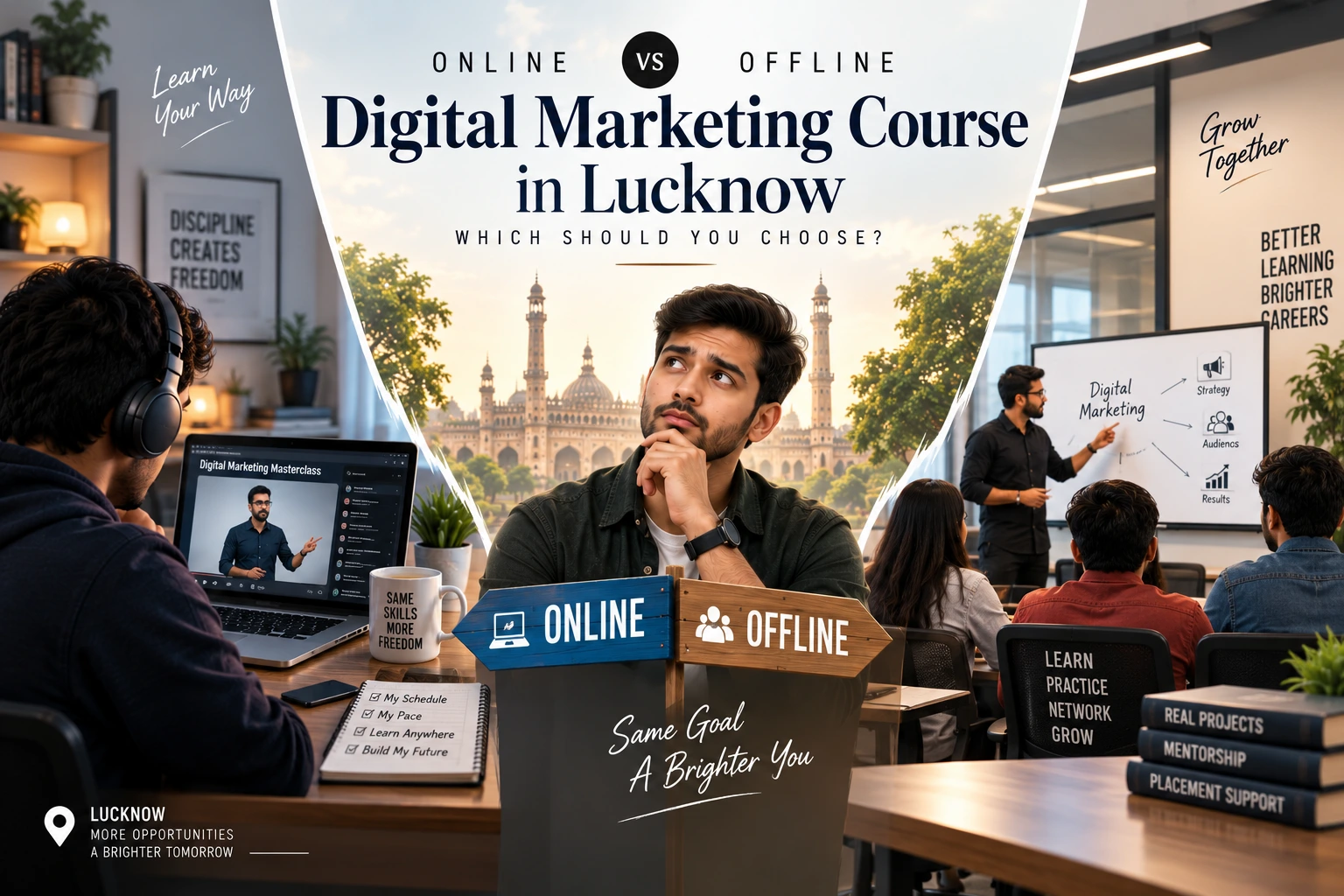
A guy I know signed up for an online digital marketing course last year. Cheapest one he could find. Recorded videos, a WhatsApp group, a PDF certificate at the end.
He finished it. Sort of. The videos are still sitting half-watched on his laptop.
Not because he was lazy. Because nobody was waiting for him. No batch, no trainer asking where he’d been, no Tuesday class he’d feel bad missing. Just him and a login he kept forgetting to use.
That’s the part nobody warns you about when you pick online over offline. It isn’t about which is better. It’s about which one you’ll actually finish.
The Question Most People Get Wrong
Everyone walks into this asking “online ya offline, kaunsa acha hai?” Wrong question.
The right one is quieter. What kind of learner are you, honestly? Because the format that works for your friend might be the exact one that fails you. And in Lucknow right now, in 2026, both options are genuinely good. The demand for digital marketers here jumped 35% in the last year. Startups, agencies, local shops going online — they all need people. So the training is worth doing. The only real decision is how you sit down to do it.
Let me break down what each one actually feels like. Not the brochure version. The real one.
Offline: For People Who Need Someone Watching
Offline is a classroom. You show up, you sit down, someone teaches you to your face.
It sounds old-fashioned. For a lot of people it’s exactly right. If you’re a complete beginner, or a 12th-pass student who’s never had a job, structure isn’t a nice-to-have. It’s the whole thing. You need a fixed time, a room to be in, a person who notices when you’re lost.
Here’s what offline gives you that a screen can’t. You raise your hand and your doubt gets cleared right then — not in a reply three days later. The trainer looks at your ad campaign over your shoulder and says “no, not like that.” You sit next to fifteen other people learning the same thing, and half the time you learn as much from them as from the trainer.
And there’s a Lucknow-specific edge. Offline institutes here usually have real relationships with local hiring companies. They run in-person mock interviews. When a Gomti Nagar agency needs a fresher, they call the institute they already know. That door doesn’t always open the same way through a screen.
The catch is simple. You have to be there. Fixed timings, daily commute, no pausing the trainer to make chai. If your life can’t hold a fixed schedule, offline turns from a strength into a wall.
Online: For People Who Already Have a Life
Online is different. It bends around you instead of the other way.
This is the one for working professionals. For the person doing a 9-to-6 who wants to switch careers without quitting first. For the mother who can only study after the kids sleep. You can’t sit in a Kamta classroom at 4pm if you’re already at a desk somewhere else. Online doesn’t ask you to.
There’s a real bonus too. Good online live courses connect you to trainers sitting in Delhi or Bangalore — people who’ve run campaigns for bigger, national brands. You get that exposure without paying metro rent. From your room in Lucknow.
But be honest with yourself about the trap. My friend’s laptop is the trap. Flexibility is freedom, and freedom is easy to waste. When nobody’s waiting for you, “I’ll watch it tomorrow” becomes a habit. Then a month’s gone. The people who thrive online already have discipline. The people who need to be pushed usually drift.
So online isn’t lazy or lesser. It just quietly hands you the responsibility that a classroom would’ve carried for you.
The One Most People Miss
There’s a third option, and in 2026 it’s quietly winning.
Hybrid. Some online, some in person.
You learn the theory and watch the sessions online, on your own time. Then you come in for the parts that need a room — project reviews, mentorship, someone checking your actual work. It’s the fastest-growing format in the city right now, and it’s producing the best salary outcomes. Students coming out of hybrid programs are landing in the ₹3.5 to ₹6.5 LPA range on average.
Makes sense when you think about it. You get the flexibility of online and the accountability of offline, without fully paying the price of either. For most people asking this question, hybrid is probably the honest answer they didn’t know existed.
Forget the Format for a Second — Check This Instead
Here’s the thing nobody tells you. Online vs offline matters far less than online-vs-offline-of-what.
A bad offline course is worse than a good online one. A brilliant online course beats a lazy classroom. So before you argue about format, check what’s actually being taught. In 2026, that matters more than everything else combined.
Ask three things. Is the trainer running real campaigns right now, or reading slides from 2023? Does the syllabus include the new stuff — AEO, GEO, Agentic AI — or is it still just SEO and Facebook ads? And is the course mostly hands-on, roughly 70% practical to 30% theory, or is it all lectures and no doing?
If a course fails those, it doesn’t matter whether it’s online, offline, or delivered by carrier pigeon. It’s teaching you skills that are already going out of date. That’s the real red flag, and it hides behind both formats equally.
Why Lucknow Itself Is the Smart Part
Quick thing worth saying. Whichever format you pick, doing this from Lucknow is a quietly good decision.
A student in Bangalore or Delhi pays a fortune just to exist there — rent, food, travel. You learn the same global skills here for a fraction of it. Same tools, same certifications, much smaller hole in your pocket. And then the remote roles open up. You can work for a Delhi or Bangalore company, at their pay, while living at Lucknow’s cost. Entry-level here starts around ₹15,000 to ₹25,000 a month, and experienced people cross ₹80,000. The ceiling isn’t low. It just doesn’t cost you much to reach for it.
Practical Tool Mastery: Local Lab Infrastructure vs Cloud Sandbox Simulations
One of the most consequential yet rarely discussed differences between online and offline digital marketing education in Lucknow centers on software access and technical troubleshooting. In modern digital marketing, you are not simply writing text or designing social graphics; you are configuring complex data pipelines across Google Analytics 4 (GA4), managing server-side Google Tag Manager (GTM) containers, configuring API conversions on Meta Events Manager, and orchestrating crawler directives in robots.txt and XML sitemaps.
When an online learner encounters a tag firing conflict or an unverified domain error in Meta Business Suite, resolving it via asynchronous chat forums or recorded screen shares often takes 48 to 72 hours of frustrating trial and error. In contrast, working inside a dedicated physical training lab with an enterprise workstation allows a senior technical instructor to inspect your live code console immediately, demonstrate the error in real-time, and show you exactly how enterprise marketing teams isolate tracking anomalies.
Furthermore, enterprise-tier marketing stacks—including SEMrush Guru licenses, Ahrefs Enterprise, Screaming Frog SEO Spider Pro, and specialized AI prompt frameworks—cost hundreds of dollars per month when purchased individually by an isolated online student. Established offline institutes in Lucknow absorb these software licensing costs within the lab environment, giving classroom students unrestricted daily access to commercial-grade marketing technology without personal out-of-pocket overhead.
Real Commute vs Cloud Tool Cost Analysis for Lucknow Learners
When evaluating the financial investment of offline versus online learning in Lucknow, students often consider only the headline tuition fee. However, a comprehensive total-cost-of-learning evaluation reveals important economic nuances across different parts of the city:
| Cost / Value Category | Pure Online Learning | Offline Classroom (Lucknow) | US Soft Hybrid Model |
|---|---|---|---|
| Monthly Commute Cost | ₹0 (Zero commute) | ₹1,200 – ₹2,500 (Metro/Auto) | ₹400 – ₹800 (2 days/wk) |
| Premium Tool Access | Self-funded or demo tools only | Included in lab hours | Included in lab + cloud VPN |
| Peer Accountability Factor | Low (Solitary study) | Very High (Daily cohort) | High (Dedicated Slack + Sprint) |
| Average 90-Day Completion Rate | Under 15% | 88% – 94% | 91% |
Where US Soft Lucknow Sits
I’ll be upfront — I’ve worked with US Soft Lucknow, so I know their setup. Not selling you a dream here, just showing you a benchmark.
They’re Lucknow’s first AI-integrated institute, ISO 9001:2015 certified, with actual modules on Agentic AI and Generative AI — the exact 2026 stuff most courses are still missing. They sit at Ayodhya Road, Kamta, and run full offline mode for people who want the classroom. So if you’ve decided offline is your format, that’s the kind of standard to hold it to. AI-first, practitioner-led, hands-on. Use it as your measuring stick, wherever you end up enrolling.
Back to My Friend
So which should you choose? The one you’ll actually finish.
If you need someone watching, go offline. If you’ve got a life that won’t bend, go online. If you want the honest best of both, go hybrid. And whichever you pick, check the syllabus before the format, because a 2023 course in a shiny classroom will still leave you behind.
My friend with the half-watched videos? He re-enrolled. Offline this time. Not because online was bad. Because he finally admitted he was the kind of person who needed a room to show up to.
That’s usually how this decision goes. Not “which course is better.” Just someone figuring out, a little late, how they actually learn.
📊 Decision Matrix: Online vs Offline vs Hybrid in Lucknow (2026)
Compare completion rates, live ad budget access, and real mentorship before choosing.
💻 100% Online (Self-Paced)
Best For: Working professionals with strict schedules.
Average Completion: ~10-15%
Ad Spend Access: Rare (simulated)
Feedback: Delayed community forums.
🏫 100% Offline (Classroom)
Best For: Beginners needing strict discipline & peer energy.
Average Completion: ~75-80%
Ad Spend Access: Good in agency environments
Feedback: Instant, in-person trainer fixes.
⚡ Hybrid (The 2026 Winner)
Best For: Anyone wanting live client agency practice + flexible recordings.
Average Completion: ~90%+
Ad Spend Access: Real client budgets & Agentic AI tools
Feedback: Daily 1-on-1 sprint reviews.
Frequently Asked Questions (FAQ)
Is an offline classroom course better than an online course in Lucknow?
For most beginners and students in Lucknow, offline training yields significantly higher completion rates and faster learning because of face-to-face mentor access, peer collaboration, and structured lab hours.
Who should choose an online digital marketing course?
Online courses are ideal for working professionals, entrepreneurs, or self-disciplined learners who need schedule flexibility and already have foundational technical comfort.
What is the completion rate difference between online and offline courses?
Self-paced online courses suffer from an average completion rate below 15%, whereas in-person cohort classes routinely exceed 85% completion due to direct accountability and hands-on lab sessions.
Can I learn complex tools like GA4, SEMrush, and Ahrefs effectively online?
While tool tutorials are available online, troubleshooting complex tracking tags, conversion funnels, and technical SEO audits is much faster when an instructor can look at your screen and guide you in person.
What is a hybrid course and does it offer the best of both worlds?
A hybrid program combines weekend in-person practical lab workshops with weekday online assignments, offering flexibility without sacrificing hands-on agency mentorship.
Does US Soft Lucknow offer offline and hybrid training options?
Yes. US Soft Lucknow provides classroom sessions with high-speed agency labs at Kamta, Ayodhya Road, as well as hybrid options. You can book a free demo class to experience the classroom setup.